Introduction
Over the last few years, there’s been a bit of a cultural shift in the UK’s business landscape.
For even longer, sustainability and environmental responsibility have been major talking points, with businesses that care about the planet and want to show that they’re committed to positive change taking small steps to reduce their environmental impact – recycling initiatives, reducing single-use plastics, and local sourcing immediately come to mind.
But more recently, it’s become quite clear – both from a customer viewpoint and a commercial one – that small, incremental steps aren’t enough, and if a business really wants to show that it’s serious, the change must come from within, and not just as a marketing message.
Coupled with this, every business looks to save costs. Whether it’s improving profitability or protecting cash flow, cutting down on expenses and maximising efficiency is the only way to stay afloat with operating fees constantly rising and profit margins tightening.
This has essentially created the perfect storm. Sustainability is a key priority; finding ways to be more cost-efficient is a business necessity. What better way to address both objectives than by rethinking your energy plan and giving it a green, cost-efficient overhaul?
This is what plenty of businesses have decided to do in these last few years, investing in renewable technologies to make their operations more efficient and their buildings more sustainable. But if you’re looking to do the same, where exactly should you start?
Begin With Your Building
Planning your business’s energy future is not something that should be done hastily, which is why it’s important to take a step back and start at the foundation. Every commercial property has its own energy profile, and what works for one business may not necessarily work for another, so start by considering how your building is used on a day-to-day basis.
For instance, perhaps your business operates within offices, where standard working hours mean energy demand is concentrated around the working day. Or perhaps you run a manufacturing facility that operates around the clock, where energy consumption is continuous and demand patterns are much more complex.
This isn’t just a short-term consideration, if you do things right, this should be a long-term strategy that supports your business as it evolves, so understanding when and where your business uses energy is a crucial foundation for success.
It’s also worth looking at the building itself. How old is it? What condition are its existing systems in? Is the heating system nearing the end of its lifespan, or does the electrical infrastructure lack the capacity for extension support?
Even seemingly minor factors, such as available roof space and the size of outdoor areas can influence which energy improvements are practical, so it’s crucial to assess your property thoroughly and think about things strategically rather than reactively.
As well as this, because we’re talking about a long-term plan that accounts for the future, it’s similarly important to think about your own business’s future. What we mean by this is that, if you’re planning to expand your workforce or perhaps increase production capacity over the next five to ten years, your energy requirements are likely to change, and so you can’t be short-sighted in your planning.
You need to think about a strategy that fits your business for the next ten years, not just the building, as that’s the only way to move forward with greater confidence and ensure everything remains fit for purpose.
Identify Where You’re Losing Money
Seeing as this strategy is designed to make your operations more cost-effective, it’s important to consider where you’re losing money in the first place. For many businesses, energy is one of the largest ongoing operational expenses, but it’s also one of the areas where inefficiencies can be the hardest to identify.
Unlike other costs that are easier to track – like staff wages or equipment expenses – energy usage often happens in the background, with businesses quite happy to pay monthly bills without actually having a clear understanding of what is driving them.
That’s why the next step is to look beyond the total figure on your energy bill and understand what is actually contributing to it. Are costs being driven by heating systems that are working harder than they need to? Are there periods when your building is using significant amounts of energy despite reduced activity?
Let’s say you’re running a retail store that’s open seven days a week, with a large back-of-house storage area that receives little customer traffic. There’s a chance that this space is still being heated, lit and powered throughout opening hours despite being rarely used, meaning you could be spending significant amounts of money maintaining an area that isn’t actually contributing to your day-to-day operations. While the cost of running this space might not seem substantial on its own, over months and years, these costs can steadily rack up, which is a huge waste considering they don’t need to.
Answering these questions requires looking at your building’s energy patterns. Reviewing historical bills, analysing consumption data, monitoring when energy demand is highest. These are things that can help highlight where improvements can be made and what areas can be prioritised, so don’t be secular by looking at them in isolation.
This is about building a complete picture of how your business uses energy so that any future decisions are based on real needs, so take the time to assess your usage properly and deliver a strategy that delivers real long-term value.
Establish Your Sustainability Objectives
The last two points have mainly revolved around costs, but as we noted at the beginning of this guide, this has as much to do with sustainability as it does financial efficiency, which is why it’s important to look inward.
Sustainability means different things to different businesses. For some, the priority might be reducing carbon emissions and working towards long-term Net Zero targets. For others, it might be about meeting customer expectations and simply preparing for future changes in legislation. The key is to understand that sustainability should not be treated as a separate objective from your wider business strategy, but instead be aligned with practical business outcomes that create long-term value.
With all of this in mind, you should start by asking what sustainability looks like for your company. Are there specific carbon reduction targets you’re looking to meet, or are you simply looking to reduce your reliance on traditional energy sources? By answering these questions early, you’re effectively setting the direction for your energy decisions, and ensuring that future investments have a clear purpose.
As we mentioned previously, it’s also worth considering how your business objectives may evolve over time – since you’re not treating sustainability as a separate objective, your environmental goals will be evolving right alongside your business. It’s important to think beyond your current priorities, and consider what your company might need in the future so that your strategy is flexible enough to support your changing ambitions.
Ultimately, understanding your sustainability objectives ensures that any future energy improvements are working towards a clear purpose. Rather than simply adopting new technologies because they’re available and ‘in trend’, you can make decisions that genuinely support the type of organisation you want to become, implementing changes in a way that’s both effective and practical.
Calculate the Return on Investment Over the Long Term
Once you’ve considered all the priorities and understood your business requirements, you can then consider the return on your investment. What we mean by this is looking beyond the initial cost of an energy project and understanding the wider financial value it can deliver over time – this is especially important when considering the combination of technologies you should be going for, which we’ll discuss in the next section.
When businesses look at making energy improvements, of course, it can be tempting to focus solely on the upfront investment. But a long-term energy strategy should consider much more than the initial price tag, it should consider payback periods, energy savings, expected lifespan – all the factors that determine true value of investment are far more important and appropriate from a business perspective over short-term savings.
It’s also important to recognise that ROI is not always measured purely in financial terms. As we’ve already discussed, improving energy performance can support your wider business objectives, whether that’s strengthening your sustainability credentials or simply reducing exposure to changing energy prices.
By taking a long-term view in your calculation, you can make far more informed decisions about the type of solution you should go for, and how it will fit your current needs and future ambitions.
Select the Right Combination of Energy Technologies
With that in mind, what actually is the right solution that will give you a substantial return on investment, help you to fulfill your sustainability objectives, and make you less reliant on the grid, outdated energy systems, and far more self-sustaining as a company?
As we alluded to above, it’s not going to be just one solution – or at least, it shouldn’t be. If you want to optimise your strategy effectively, it’s important to understand why renewable technologies work best together, and consider combining them to achieve a more balanced and efficient ecosystem.
Solar PV
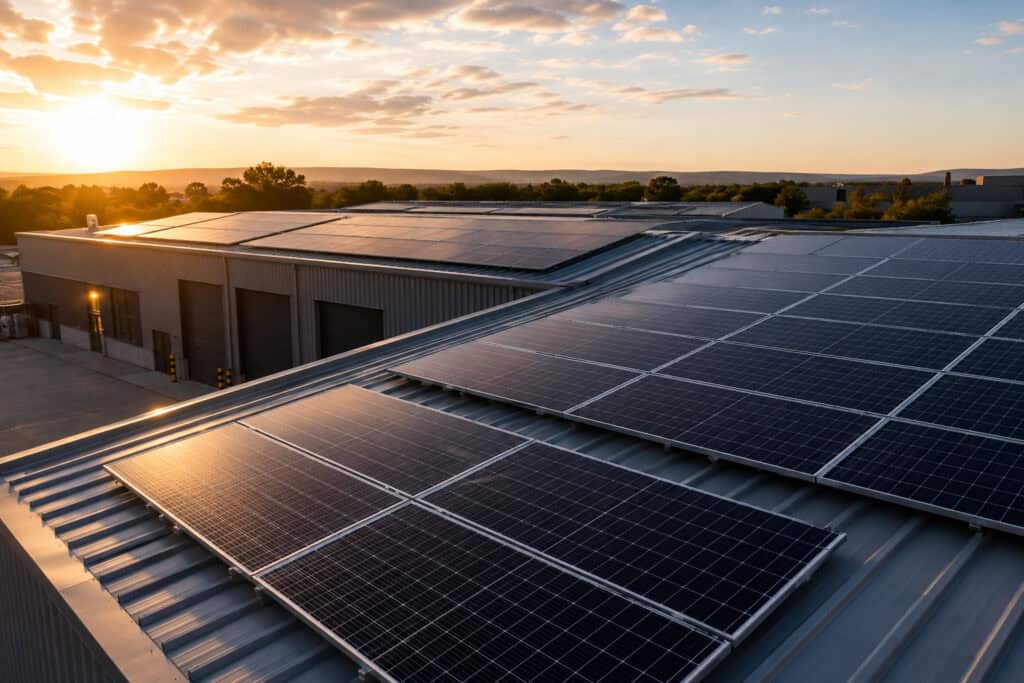
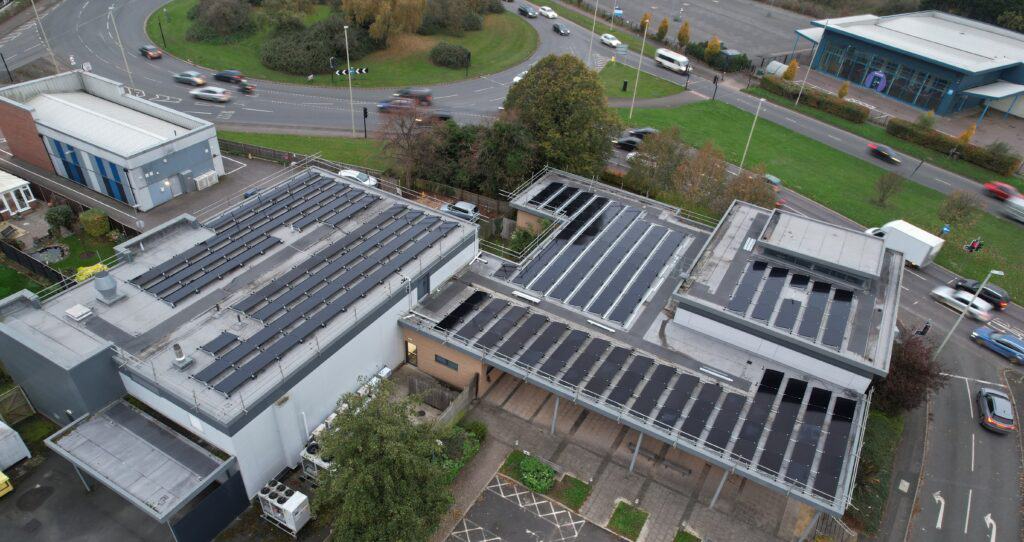
This starts with solar PV. For many businesses, commercial solar panels form the foundation of a wider energy strategy because they allow them to generate electricity directly from their own premises rather than relying solely on the grid.
Bear in mind, energy prices from the grid are rarely predictable. On the contrary, businesses are continuously subject to fluctuations and market volatility, so by generating electricity yourself, you’re effectively reducing your exposure to external changes and gaining greater control of your long-term energy costs.
Battery Storage
It’s important to be aware, however, that solar PV generation and business energy demand don’t always align perfectly. There might be times when your system is producing more electricity than your business actually needs, particularly during periods of strong sunlight when demand is lower.
Without a way to make use of this excess energy, you’re not maximising the full value of the electricity you generate, which isn’t going to help with your ROI or reduce your reliance on the grid – since much of this excess energy might be exported back to it. This is why pairing solar PV with commercial battery storage is such a common approach.
By storing surplus energy generated during periods of higher production, battery systems allow businesses to use that electricity at a later time when demand increases, thus making better use of the energy being produced and improving the overall efficiency of your strategy.
Battery storage can also provide greater flexibility in how and when energy is consumed. Let’s say you’re going for a hybrid approach, whereby the grid is not totally removed from your sustainability plan. When grid prices are higher and energy demand increases, you can switch to your stored electricity and ensure you’re not subject to those extra costs, thus making it a far wiser investment than simply installing solar panels and hoping that your energy generation perfectly matches business consumption.
Heat Pumps
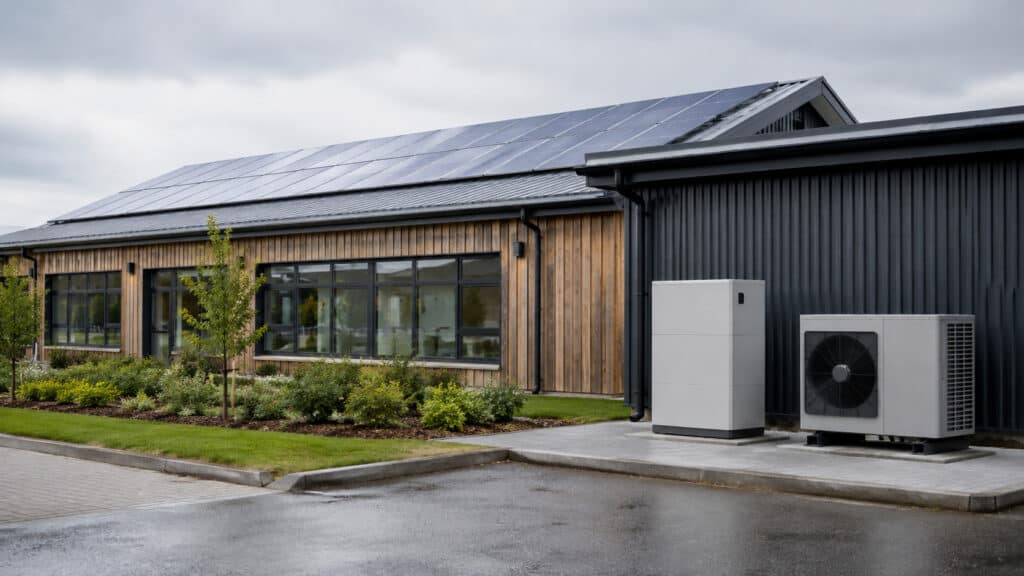
Another common approach is to pair solar PV and battery storage with commercial heat pumps, which are an increasingly popular alternative to traditional heating systems. Unlike those conventional systems that generate heat by burning fuel, heat pumps work by transferring heat from the surrounding environment into the building. This then allows them to provide efficient heating while using electricity as their primary energy source, rather than creating it from scratch.
With heating being one of the biggest energy demands within a commercial building, finding more efficient ways to provide it can have a significant impact on your overall energy performance, especially considering how much heating is typically required throughout the colder months.
If your business is operating larger premises, specifically, improving the way your heat is generated and managed is going to have a significant effect on your overall budget, potentially even freeing up thousands of pounds over the long-term, so it’s important to take that into account if you want your strategy to be ‘fuller’ and more financially effective.
Additional Considerations: HVAC and EV Charging
HVAC, too, is another consideration. It’s become a well-known fact that old HVAC systems become less efficient over time, requiring more energy to deliver the same level of heating, cooling, or ventilation.
Many also lack the advanced controls and monitoring capabilities that allow businesses to better manage when and how energy is being used, which isn’t helpful when it comes to optimising your overall energy performance.
By reviewing your existing HVAC setup as part of a wider strategy, you can identify whether your current systems are still meeting your needs or whether you could improve them by integrating commercial HVAC into the broader improvements you’re already investing in.
Likewise, you might consider how EV charging could form part of your energy plan. As more businesses transition towards electric vehicles, commercial EV charging is becoming an increasingly important consideration, whether it’s to support company vehicles or simply provide facilities for employees and customers.
Even if that’s not on your agenda right now, it’s still important to be aware of how much electricity demand EV charging adds. Without proper planning, introducing multiple charging points can significantly change your energy usage patterns, so if you think you might bring it into your approach in the future, it’s a good idea to ensure your wider improvements are designed to accommodate these changes and avoid having to make any costly adjustments down the line.
Conclusion
Essentially, all of this is about building a resilient energy strategy that can grow with your business. In this context, resilience means being able to adapt – to perform and remain effective, despite changes that might occur. In other words, a resilient strategy is not one that simply solves today’s challenges, but gives your business the flexibility to respond to future demands.
That’s why the most successful energy plans aren’t based on individual decisions made in isolation. They’re built around a clear understanding of where your business is now, how your building operates, how it uses energy, and where things might go over the next few years.
By taking this approach – and taking the time to really understand where the gaps are and where the opportunities for improvement lie – every solution becomes part of a wider plan that supports your business and helps it to evolve.
We talked at the beginning of this piece about assessing your building and identifying cost inefficiencies, but if you’re looking to assess thoroughly and ensure you’re creating a plan that works for you, make sure you get in touch.
At GSM Ltd, we can help you assess your current requirements and develop an energy system that’s tailored to your building and your goals, making sure no opportunity is missed. Above anything else we’ve discussed, that’s the first step that will actually put you on the road to creating an efficient, sustainable future, and make this exciting transformation a reality.